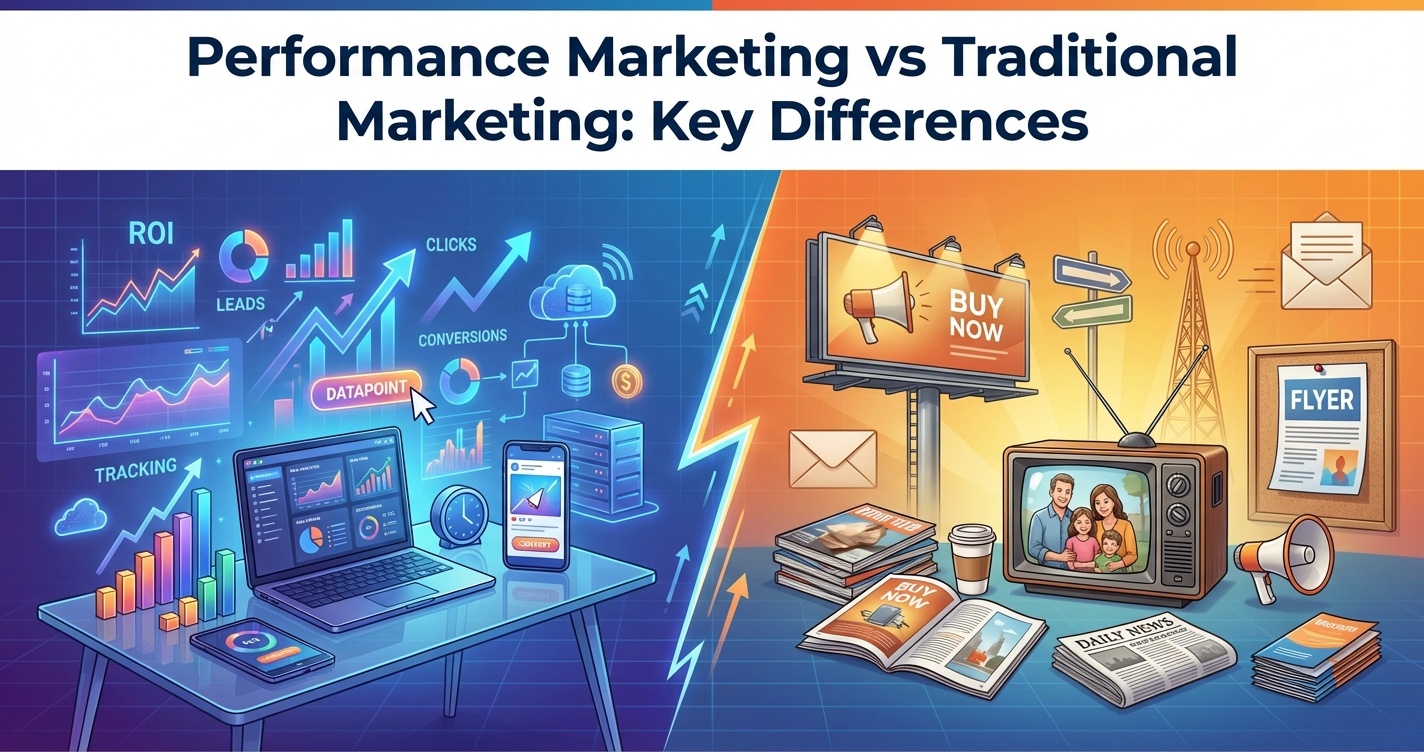
Performance Marketing vs Traditional Marketing: Key Differences
Here’s a scenario that plays out in boardrooms across India every single day: A business owner sits down with their marketing team and asks the age-old question. “Should we pour our budget into traditional channels like TV, print, and billboards? Or should we go all-in on performance marketing where we can actually track every single rupee?”
It’s a genuine dilemma. And honestly, there’s no one-size-fits-all answer. What works for a massive conglomerate with a ₹50 crore branding budget might bankrupt a small business trying to make its mark. The smart move? You need to understand both approaches deeply before deciding where your money goes.
That’s exactly what we’re going to do in this article. We’ll break down performance marketing versus traditional marketing in ways that actually make sense for your business. No jargon, no fluff—just practical insights backed by real market data.
Let’s dive in.
Understanding the Two Approaches
What is Traditional Marketing?
Traditional marketing is what most of us grew up with. It’s the advertising model that’s been around for decades—the billboards you pass on the highway, the TV commercial during your favorite cricket match, the full-page ad in your morning newspaper, and that radio jingle you can’t get out of your head.
At Flixaro, we’ve worked with businesses across industries who have used traditional marketing channels for years. We’ve seen the good, the bad, and the forgettable. Traditional marketing typically involves one-way communication where brands push their message out to a broad audience and hope something sticks. Our digital marketing services help businesses navigate both worlds effectively.
The key characteristics of traditional marketing include large upfront investments, difficulty in measuring exact returns, and reaching masses of people through established media channels. Think of it as the megaphone approach—you’re broadcasting to as many people as possible and hoping the right ones are listening.
What is Performance Marketing?
Performance marketing is the newer kid on the block, but it’s quickly become the darling of modern businesses. It’s digital, data-driven, and best of all—you only pay for the results you actually get.
When we talk about performance marketing, we’re referring to digital advertising channels where you pay based on specific actions. These actions could be clicks (pay-per-click), leads generated (cost-per-lead), or sales made (cost-per-acquisition). The biggest players in this space include Google Ads, Meta Ads (Facebook and Instagram), LinkedIn Ads, and programmatic advertising platforms.
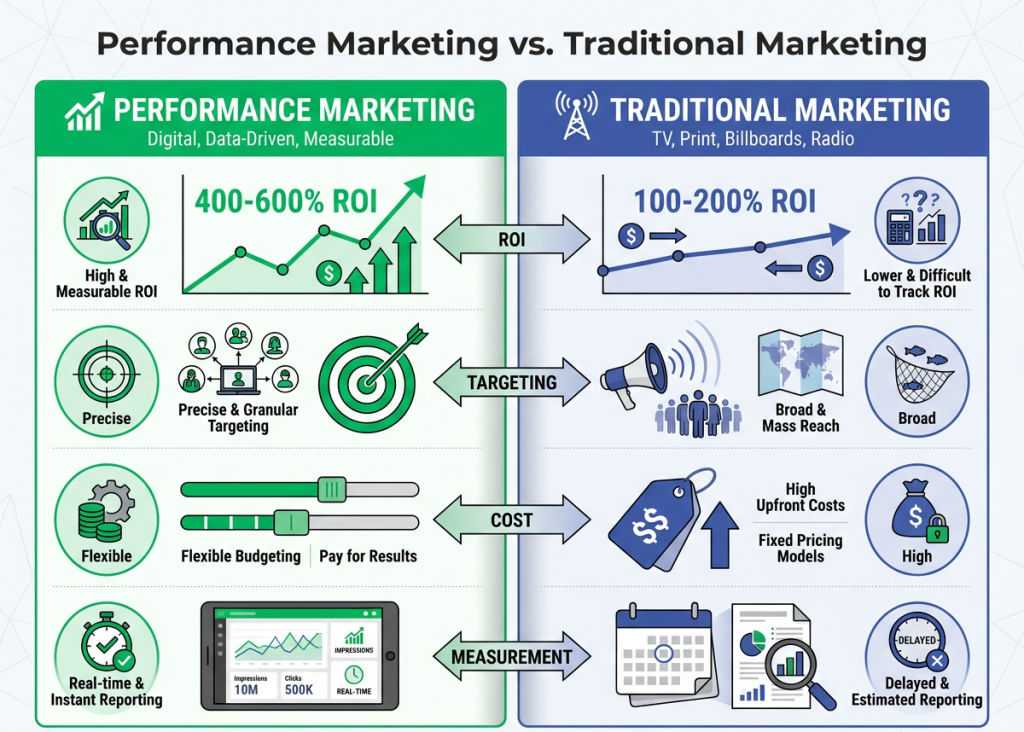
The fundamental difference with performance marketing is measurability. You know exactly what’s working and what’s not. You can see in real-time how many people saw your ad, how many clicked, how many converted, and most importantly—what each customer cost you to acquire.
The Numbers: Market Data and Statistics
Before we get into the nitty-gritty, let’s look at how the market has shifted over the past few years. The data tells a fascinating story.
The global digital advertising market reached approximately $650 billion in 2025, and it’s projected to cross $800 billion by 2027. In India specifically, digital ad spending has been growing at a compound annual growth rate (CAGR) of about 25%, reaching around ₹50,000 crore in 2025. Meanwhile, traditional advertising in India has seen marginal growth of just 3-4% annually.
This shift isn’t just about preference—it’s about results. Businesses are following the eyeballs, and consumers are spending more time online than ever before. The average Indian adult now spends over 4 hours daily on digital media, compared to about 2 hours with traditional media.
Here’s a breakdown of how marketing budgets have evolved in India over the past five years:
| Year | Digital Marketing Share | Traditional Marketing Share |
|---|---|---|
| 2020 | 35% | 65% |
| 2021 | 42% | 58% |
| 2022 | 50% | 50% |
| 2023 | 58% | 42% |
| 2024 | 65% | 35% |
| 2025 (Projected) | 72% | 28% |
The trend is clear. Digital is eating into traditional’s share year after year. But does that mean traditional marketing is dead? Not necessarily—we’ll get into that later.
Key Differences: Side-by-Side Comparison
Let’s break down the fundamental differences between these two approaches in ways that matter for your business decisions.
Cost Structure and Investment
Traditional marketing typically requires substantial upfront investment. A 30-second TV spot during prime time in India can cost anywhere from ₹50,000 to several crores depending on the channel and time slot. A full-page magazine advertisement can range from ₹50,000 to ₹5 lakhs. Billboards in major cities come with monthly rentals that can go into lakhs.
Performance marketing, on the other hand, offers flexibility. You can start with a daily budget of just ₹500 on Google Ads and scale up as you see results. Most platforms operate on auction-based pricing, meaning you compete for ad space with other advertisers. This keeps costs relatively democratic—you only pay what the market will bear.
Measurability and Tracking
This is where performance marketing absolutely shines. When you run a Google Ads campaign, you can track exactly how many people saw your ad, how many clicked, how many filled out a form, and how many made a purchase. Every single metric is available in real-time.
Traditional marketing has always struggled with attribution. Did that customer who walked into your store see your billboard? Did they scroll past your Instagram ad instead? When someone buys something after seeing your TV commercial, was it the commercial that convinced them, or was it the recommendation from a friend? These questions are nearly impossible to answer with traditional methods.
Some traditional marketers will tell you that brand awareness can’t be measured, and there’s truth to that. But in an era where CFOs want ROI on every rupee spent, the inability to measure impact is becoming a dealbreaker.
Audience Targeting
With traditional marketing, you’re often targeting broad demographics. A TV commercial during a cricket match might reach millions of people, but many of them aren’t your potential customers. You’re paying to reach everyone, whether they’re interested or not.
Performance marketing allows for laser-focused targeting. You can show your ads only to people in specific locations, of certain ages, with particular interests, or who have previously visited your website. You can even target people who have similar characteristics to your existing customers. This precision means less wasted budget and higher conversion rates.
At Flixaro, we’ve seen client after client achieve remarkable results simply by improving their targeting. One e-commerce client in Chennai reduced their cost per acquisition by 60% just by refining their audience segments on Meta Ads.
Speed and Flexibility
When you want to launch a traditional marketing campaign, you’re looking at lead times of weeks or months. You need to book ad space, create materials, get approvals, and coordinate with multiple vendors. Making changes mid-campaign is often impossible or extremely expensive.
Performance marketing campaigns can go live within hours. You can create an ad in the morning, launch it at noon, and optimize it based on afternoon results. If something isn’t working, you can pause it immediately and try a different approach. This agility is particularly valuable for businesses testing new markets or promoting time-sensitive offers.
ROI Comparison: What the Data Shows
Let’s get into the numbers that matter most—return on investment. We’ve compiled data from various industry reports and our own client experiences to give you a realistic picture.
Average ROI by Channel
Different marketing channels deliver different returns. Here’s what businesses in India typically see:
| Marketing Channel | Average ROI | Attribution Window |
|---|---|---|
| Search Ads (Google) | 400-600% | 30 days |
| Social Media Ads (Meta) | 250-400% | 28 days |
| Display Advertising | 150-250% | 30 days |
| TV Advertising | 150-250% | 90 days |
| Print Advertising | 100-200% | 60 days |
| Billboard/OOH | 100-150% | 90 days |
| Radio | 100-150% | 30 days |
These numbers are averages and vary significantly by industry, target audience, and creative execution. A well-optimized performance marketing campaign can deliver returns far above these averages, while a poorly executed traditional campaign might deliver nothing.
The key point here is the attribution window. Performance marketing typically shows results within 30 days, making it easier to connect marketing spend to revenue. Traditional marketing often has longer attribution windows—customers might see your billboard today and convert three months later, making it harder to prove the connection.
When To Use Traditional Marketing?
Now, we’re not here to completely write off traditional marketing. There are absolutely situations where it makes sense, and smart businesses know when to use each approach.
Traditional marketing still excels at building broad brand awareness. If you’re launching a new brand or entering a new market where nobody knows you, a well-placed billboard or TV campaign can create recognition that performance marketing simply can’t match in the short term.
There’s also something to be said for prestige and credibility. A full-page ad in a prestigious magazine or a billboard in a premium location signals a certain level of establishment and trustworthiness. For high-ticket items where trust is crucial, traditional marketing can provide that veneer of credibility that performance ads sometimes can’t.
Certain audiences are also still more reachable through traditional channels. Older demographics in India, particularly in Tier 2 and Tier 3 cities, may not be as digitally engaged. If your target customer is over 55 years old and lives in a smaller town, traditional channels might actually reach them more effectively.
We worked with a healthcare client last year who was trying to reach senior citizens for their retirement community projects. Our digital campaigns delivered leads, but the quality and conversion rate were poor. When they added newspaper and radio advertising in specific regions, they saw a dramatic improvement in lead quality. The lesson? Know your audience and meet them where they are.
When To Use Performance Marketing?
For most modern businesses, especially those in the digital age, performance marketing is the clear winner for several reasons.
First, there’s the measurability we already discussed. When every rupee is traceable, you can optimize continuously. You can test dozens of ad variations, landing pages, and targeting options in the time it takes traditional marketers to approve a single creative.
Second, performance marketing scales with results. If your campaigns are profitable, you can increase your budget and generate more revenue. With traditional marketing, scaling often means simply buying more ad space at similar returns—there’s no guarantee that doubling your spend will double your results.
Third, the barrier to entry is low. You don’t need a massive budget to get started. A small business with ₹10,000 per month can compete for attention alongside the biggest brands in their space. The auction-based system rewards relevance and quality, not just deep pockets.
Fourth, the creative flexibility is unmatched. You can test different messages, visuals, and formats instantly. If one ad isn’t resonating, you can swap it out for another in minutes. This continuous optimization is impossible with traditional campaigns that might run for months without changes.
Finally, performance marketing allows for remarketing—showing ads to people who have already interacted with your brand. This is incredibly powerful for conversion. Someone who visited your website last week but didn’t purchase might be convinced to buy after seeing a targeted ad reminding them what they’re missing.
Making the Right Choice for Your Business
So here’s the million-dollar question: which approach should you choose? The answer, as with most business questions, is “it depends.”
Here’s a framework we use at Flixaro when advising clients:
Choose performance marketing if you have a product or service that can be sold online, you need to track ROI precisely, you’re working with limited budgets, you’re testing new markets or products, or your target audience is digitally active.
Choose traditional marketing if you’re building a new brand from scratch, you’re targeting older demographics in specific regions, you have a massive budget for brand building, or you’re in an industry where prestige matters significantly.
The smartest approach for most businesses is actually a hybrid. Use performance marketing to generate immediate leads and sales while testing what resonates with your audience. Then, once you’ve identified a winning formula, consider using traditional channels to amplify your message and build broader awareness.
Think of it this way: performance marketing is like a precision sniper, targeting specific prospects with accuracy. Traditional marketing is like an artillery barrage—less precise but covering more ground. You might need both depending on the battle you’re fighting.
Budget Allocation: The 70-20-10 Rule
Based on our experience working with hundreds of businesses, here’s a practical framework for allocating your marketing budget:
The 70% allocation should go toward proven performance channels—these are the platforms and tactics where you know you can generate measurable returns. For most businesses, this means Google Search ads for high-intent customers, Meta ads for awareness and lead generation, and SEO for organic long-term growth.
The 20% should be reserved for experimentation. Digital marketing evolves rapidly, and new platforms emerge regularly. By allocating a portion of your budget to testing new channels—like emerging social platforms, newer ad formats, or innovative programmatic opportunities—you stay ahead of the curve without risking your core revenue channels.
The final 10% can go toward brand building. Even the most performance-focused businesses benefit from brand awareness. Whether it’s sponsoring events in your industry, appearing on podcasts, or strategic traditional placements in niche publications, this investment in brand equity pays dividends over time.
This isn’t a rigid formula—it’s a starting point. As your business evolves and different channels prove their value, you’ll naturally adjust these percentages. The key is having a structured approach rather than arbitrarily splurging across channels.
The Future: Where Things Are Heading
If the current trends continue—and all signs suggest they will—performance marketing will only become more dominant. Artificial intelligence is making ad targeting even more precise, and measurement tools are becoming increasingly sophisticated.
But traditional marketing isn’t going to disappear entirely. It will evolve, find new forms, and continue to serve specific purposes. The businesses that win will be those who understand when to use each tool and don’t cling to old methods just out of habit.
Final Thoughts
Here’s what we’ve learned after years of helping businesses navigate this exact decision:
Performance marketing vs traditional marketing isn’t about choosing the “right” method. It’s about understanding the strengths and weaknesses of each and deploying them strategically based on your specific business goals, target audience, and budget.
For most businesses in today’s digital-first world, performance marketing offers better measurability, faster results, and more efficient use of limited budgets. But traditional marketing still has its place for brand building and reaching certain audiences.
The best approach? Start with performance marketing to generate results and prove ROI. Then, as you scale, consider adding traditional channels strategically for broader impact.
Ready to see what performance marketing could do for your business? Let’s have a conversation about your specific situation and find the strategy that works best for you. Check out our performance marketing services or learn more about our digital marketing expertise.
This article is brought to you by Flixaro, a digital marketing agency helping businesses across India unlock their growth potential through data-driven marketing strategies.